
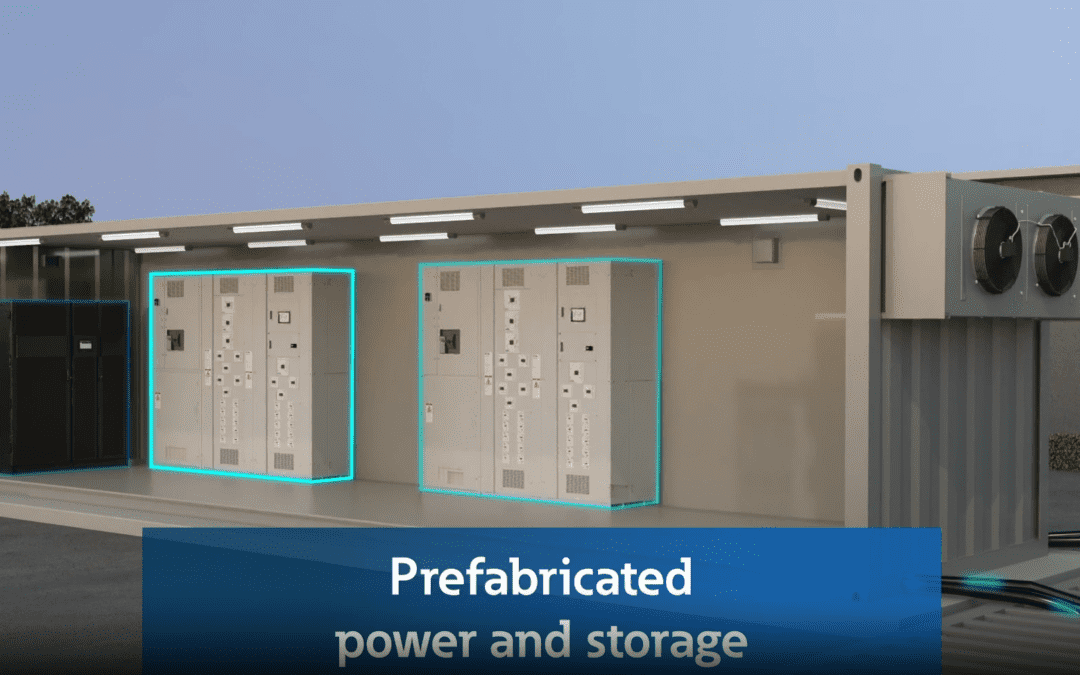
The Eaton/NVIDIA Beam Rubin DSX announcement is getting attention for the obvious reasons: AI, hyperscale infrastructure, and the scale of the coming data center build cycle. Eaton says the platform is designed as an end-to-end, modular power-and-cooling implementation integrated with the NVIDIA Vera Rubin DSX AI Factory reference design and the NVIDIA Omniverse DSX blueprint, with the stated goal of bringing new capacity online in months instead of years. Eaton also frames the addressable market as part of a nearly $7 trillion global data center buildout opportunity.
From a contractor’s perspective, the headline is not just “bigger data centers” or “more AI load.” The real headline is that the market is trying to industrialize delivery. NVIDIA’s March 16 release describes Vera Rubin DSX as a reference design for codesigned AI infrastructure, spanning compute, networking, storage, power, cooling, and controls, while Omniverse DSX is positioned as the digital-twin layer for design, simulation, and operational validation before deployment. That matters because once owners and developers start buying around a reference architecture, the job shifts from custom one-off engineering toward repeatable execution, prefabrication, and commissioning discipline.
That shift is overdue. The International Energy Agency says global data center electricity consumption is set to more than double to about 945 TWh by 2030, and it warns that grid constraints, interconnection queues, and long lead times for transmission and critical electrical equipment could delay around 20% of planned data center projects if those risks are not addressed. Eaton’s own announcement is explicitly aimed at that bottleneck, including modular delivery, onsite power options, and flexible-load strategies it says could unlock as much as 100 gigawatts of additional grid capacity for new data center development.
For contractors, that means the conversation is moving beyond “Can you install the gear?” to “Can you de-risk schedule, energization, startup, and future scale?” That is a different business.
In this environment, the winners are going to be the teams that can integrate electrical, mechanical, controls, and constructability early. AI factories are not forgiving jobs. Power density is rising. Cooling topology is changing. Owners want speed to revenue, not just substantial completion. And the tolerance for field rework gets smaller as rack power climbs and site power becomes the limiting factor. NVIDIA’s release is explicit that these facilities require coordinated design across infrastructure, power, cooling, networking, software, and compute. Contractors who still treat those scopes as separate silos are going to have trouble keeping up.
From where I sit, there are five practical implications.
First, prefabrication stops being optional and starts becoming the delivery model. Eaton says Beam Rubin DSX is meant to be modular, scalable, and pre-engineered, with scope extending from grid infrastructure through power distribution and chip-level cooling, scaling from megawatts to hundreds of megawatts. If that model gains traction, owners will increasingly expect skid-based and factory-built assemblies, cleaner site interfaces, less onsite labor, and faster repeatability across campuses. Contractors who can coordinate prefab MEP racks, power skids, piping modules, and controls integration will have a real advantage.
Second, utility and energy strategy become part of preconstruction, not a downstream activity. The old sequence—design the building, then chase utility answers—does not work on compressed AI schedules. The IEA is clear that local grid impacts are concentrated and serious, and Eaton is clearly positioning around onsite generation and flexible load management to get projects moving faster. In practice, that means the contractor’s precon team needs to be involved in interconnection risk, temporary power strategy, phasing, campus expansion logic, and what “day one operable” actually means if full utility capacity lands later.
Third, mechanical contractors need to get comfortable operating closer to the chip. Eaton’s announcement is not just about switchgear and distribution. It explicitly includes advanced cooling at the chip level. Whether the final answer is liquid cooling, hybrid cooling, rear-door heat exchange, CDU-based architectures, or some combination, the takeaway is the same: the mechanical scope is moving deeper into the IT environment. That raises the bar for water quality, leak detection, redundancy logic, startup procedures, service access, controls integration, and turnover documentation.
Fourth, digital twins are becoming a field tool, not just a design visualization. Eaton says its technologies are being provided as SimReady 3D assets in OpenUSD for Omniverse DSX so customers can design, simulate, and validate energy infrastructure before construction. NVIDIA similarly describes Omniverse DSX as a way to simulate layouts, power topologies, thermal behavior, and operational policies before deployment. For contractors, that should translate into better clash prevention, clearer installation sequencing, earlier controls validation, and more meaningful commissioning prep. The opportunity is real, but only if the construction team is at the table early enough to use the model to drive means-and-methods decisions instead of just reviewing pretty renderings.
Fifth, commissioning becomes the product. On these projects, the owner is not just buying a building. They are buying usable compute capacity. That puts enormous weight on startup planning, integrated systems testing, failure-mode testing, controls sequences, trending, and turnover quality. If the industry is moving toward reference architectures and repeatable deployments, then repeatable commissioning outcomes will matter just as much as repeatable hardware packages.
My contractor read on this announcement is straightforward: Eaton and NVIDIA are not only talking about technology. They are talking about compressing the delivery stack. They want a more standardized path from utility interface to energized IT load, supported by modular equipment and digital validation.
That is a major opportunity for contractors, but it comes with a warning. Speed does not remove risk. It concentrates it. The firms that do well in this next cycle will be the ones that can coordinate power, cooling, controls, logistics, startup, and owner expectations as one system. The firms that struggle will be the ones still treating these projects like conventional mission critical work with a few bigger numbers on the drawings.
The market is telling us where it is going: more prefabrication, more integrated delivery, more simulation before steel hits the ground, and much less tolerance for fragmented execution.
For contractors, the message is simple: the next competitive advantage is not just building capacity. It is building certainty.